On 12 and 13 November 2026, COMEX gold futures closed at $3,885.30 and $3,886.30 an ounce, their lowest closes since early October 2025. That is about 27% below the record close of $5,318.40 set on 29 January. If you own a Krugerrand, the world's best-known gold coin, its value has moved with every one of those swings.
Maybe you inherited one, found one in a drawer, or are thinking of buying your first. Either way, two questions come first: what exactly is this coin, and what would someone pay you for it today?
The short answer: a Krugerrand is a South African gold bullion coin that contains exactly one troy ounce of pure gold (or a fraction of an ounce for the smaller sizes). Its value is that gold content times the spot price. At the 13 November close, that made a 1 oz Krugerrand worth about $3,886 in gold. On 16 November, one large dealer was selling it for 2.0% over spot and buying it back for 2.7% under.
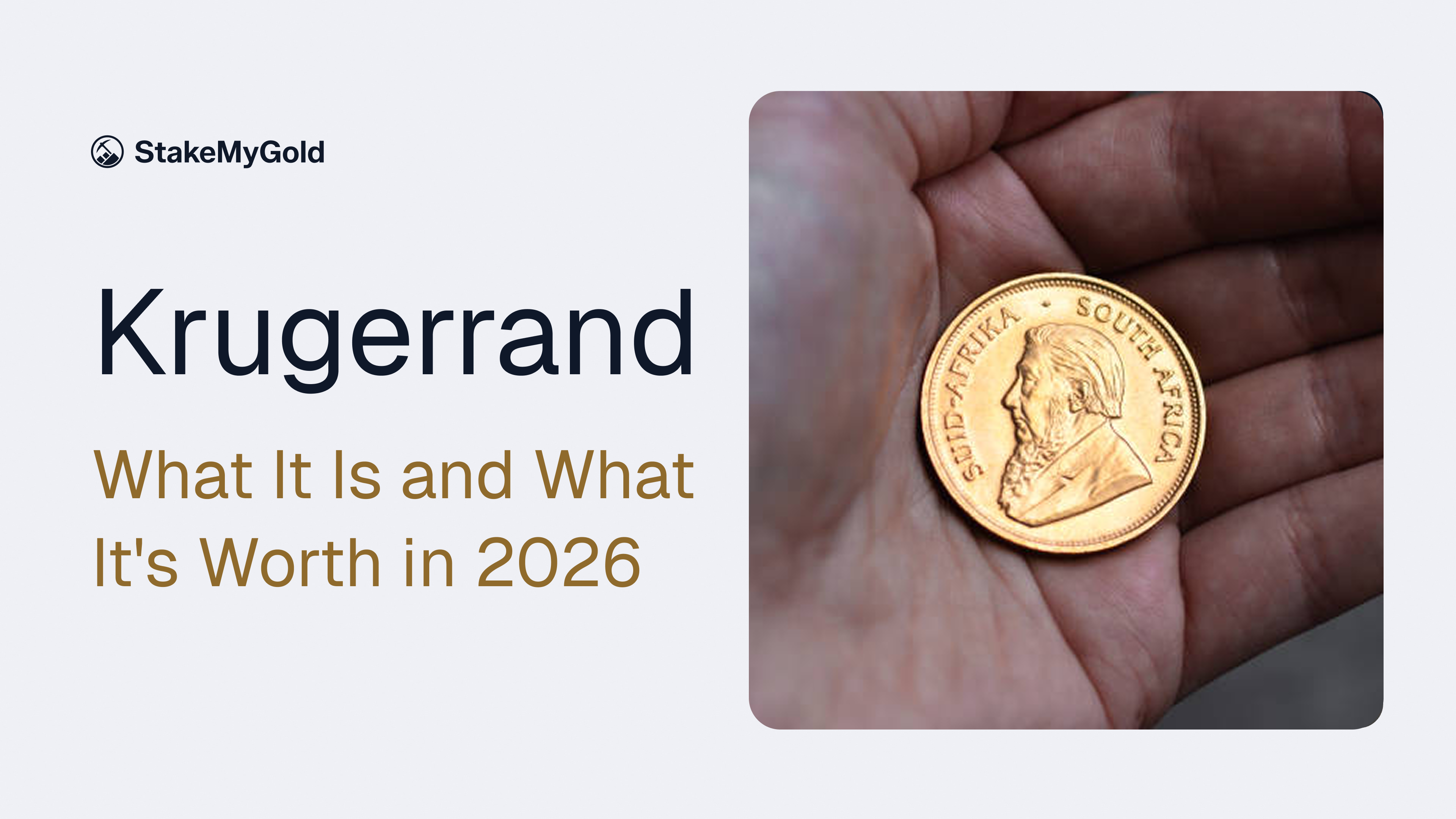
A Krugerrand is a South African gold bullion coin, made since 1967, that contains exactly one troy ounce of pure gold in a 22-karat gold and copper alloy. Smaller versions hold 1/2, 1/4 or 1/10 of an ounce. Bullion means the coin is valued for its metal, not its rarity. The name joins Paul Kruger, a 19th-century president of the South African Republic whose portrait is on the front, with the rand, South Africa's currency. A springbok antelope is on the back, according to CoinWeek's history of the coin.
The coin was built for one job: to sell South African gold to private buyers around the world. It does that in a simple way. The London Bullion Market Association (LBMA), the main trade body for the gold market, notes that it was designed to contain exactly one ounce of fine gold and carry no face value. Fine gold means pure gold, not counting other metals in the coin.
Two South African organizations make it. The South African Mint strikes the coins, and Rand Refinery, a refinery accredited to the London Good Delivery standard since 1921, produces the gold blanks they are struck on, according to the LBMA. The Mint describes it as a legal tender gold coin denominated in ounces of pure gold, not in rand. That is why its value is simply the value of its gold, plus whatever a dealer adds or takes off.
A 1 oz Krugerrand weighs 33.93 grams and is 32.77 mm across. It contains 31.103 grams of pure gold, which is one troy ounce. A troy ounce is the unit used for precious metals, about 31.1 grams, roughly 10% heavier than the ounce on a kitchen scale.
The extra weight is copper. The Mint makes the coin from 11/12 pure gold and 1/12 copper, which is 22-karat gold, or 91.67% pure. Copper makes the coin harder than pure gold, so it scratches less easily, and gives it the reddish tinge the LBMA describes. To hold a full ounce of gold at 91.67% purity, the coin has to weigh 31.103 / 0.9167 = 33.93 grams.
The South African Mint introduced three smaller sizes in 1980. All four sizes are 22-karat:
| Size | Pure gold | Gross weight | Diameter |
|---|---|---|---|
| 1 oz | 31.103 g | 33.930 g | 32.77 mm |
| 1/2 oz | 15.552 g | 16.965 g | 27.07 mm |
| 1/4 oz | 7.776 g | 8.482 g | 22.06 mm |
| 1/10 oz | 3.110 g | 3.393 g | 16.55 mm |
Gross weights and diameters from the Dillon Gage specification table; pure gold content is the stated fraction of a troy ounce.
If you want the background on karats, fineness and why a troy ounce is not a regular ounce, our guide to troy ounces, karats and fineness covers it in full.
For the coin's 50th anniversary in 2017, the South African Mint struck silver and platinum Krugerrands for the first time. The silver Krugerrand contains one troy ounce of silver, and the Mint lists it as a 1 oz silver bullion coin of over 99.9% purity. A silver Krugerrand is priced off the silver price, so it is worth a small fraction of the gold coin. Our page on how much silver is worth explains that math.
A proof Krugerrand is a collector version struck with polished dies, which gives a mirror background and frosted design. Proofs are made in small numbers and sold at a higher markup than bullion coins. A plain bullion Krugerrand, sold with a random year, is the one most people own.
For about a decade, the Krugerrand had the gold bullion coin market to itself. Limited proof and proof-like coins were struck from 1967 to 1969, and the LBMA says mass production of the 1 oz coin began in 1970. It had no real competitor until Canada launched the Maple Leaf in 1979.
Sales were huge. The LBMA counts more than 58 million troy ounces of Krugerrands issued since 1970, including 6,012,293 coins in 1978 alone. CoinWeek reports that by 1980 the Krugerrand made up 90% of the global gold coin market, and that the United States was its largest buyer.
They are not, but they were once banned from import into the US. In the mid-1980s, many countries put sanctions on South Africa over apartheid, its system of racial segregation. On 1 October 1985, President Reagan signed Executive Order 12535, which ordered that "the importation into the United States of South African Krugerrands is prohibited", effective 11 October 1985.
The ban covered new imports only. Americans who already owned Krugerrands could keep, sell and trade them. The National Archives lists Executive Order 12535 as revoked by Executive Order 12769 on 10 July 1991, after South Africa began dismantling apartheid. Today Krugerrands are bought and sold freely in the US.
The sanctions hit sales hard. CoinWeek's mintage figures show 1 oz production falling from 2,685,466 coins in 1984 to 21,040 in 1986. The LBMA says few Krugerrands were exported over the next two decades, and that in 2018 the coin regained its status as the world's best-selling gold bullion coin, with 2.2 million ounces issued that year.
A Krugerrand is worth its gold content times the spot price of gold. The spot price is the current market price for one troy ounce of gold for immediate delivery. That figure is the coin's melt value: what the gold alone is worth before any dealer markup.
Melt value = ounces of pure gold x spot price
Because a Krugerrand states its gold content in round fractions of an ounce, the math is easy:
| Size | Melt value at $3,886.30 (COMEX close, 13 Nov 2026) |
|---|---|
| 1 oz | $3,886 |
| 1/2 oz | $1,943 |
| 1/4 oz | $972 |
| 1/10 oz | $389 |
Melt value only. Dealers sell above it and buy below it. Spot prices from different sources differ slightly at any moment.
The spot price you see on the news is usually close to the front-month COMEX futures price. Our explainer on how the gold price is set explains why the numbers on different websites rarely match to the dollar.
To a buyer, a 1 oz Krugerrand is worth slightly less than the spot price. On Monday 16 November 2026, at about 12:50 pm New York time, Kitco showed spot gold at $3,861.20 (ask) and $3,859.20 (bid). At that moment it was:
So a coin with $3,859 of gold in it would have fetched about $3,754 from that dealer, 2.7% below the spot bid. That gap is normal. Dealers have to cover testing, handling and the risk that gold falls before they resell the coin.
A premium is what a dealer charges above the spot price. A buyback price is what the dealer pays you. Comparing the same coins at the same dealer at the same time removes most of the noise, so here is what Kitco showed on 16 November:
| 1 oz gold coin | Purity | Dealer price (wire) | Premium over spot | Buyback | Buyback vs spot bid | Gold must rise to break even |
|---|---|---|---|---|---|---|
| South African Krugerrand | 91.67% | $3,940.29 | +2.0% | $3,754.04 | -2.7% | 5.0% |
| American Gold Eagle | 91.67% | $4,030.30 | +4.4% | $3,811.80 | -1.2% | 5.7% |
| Canadian Maple Leaf | 99.99% | $4,030.30 | +4.4% | $3,831.05 | -0.7% | 5.2% |
Kitco buy and sell pages, 16 Nov 2026, about 12:50 pm ET; spot ask $3,861.20, bid $3,859.20. Break-even is the rise in gold needed for the buyback price to reach what you paid. Kitco listed a 1 oz Britannia without a price at the time.
Three things stand out:
Small sizes cost more per ounce. SD Bullion listed a 1/10 oz Krugerrand at $436.86, about 13% over the value of its gold, and the 1/2 and 1/4 oz coins at roughly 6% to 7% over (all three were out of stock at the time). If you want to see why premiums exist and how coins compare with bars, read our breakdown of gold coins vs bars. The same three-price pattern applies to bars, as our guide to what a gold bar is worth shows.
Say you inherit three 1 oz Krugerrands and two 1/10 oz Krugerrands, and you want to know what they are worth on 16 November 2026.
Step 1: count the gold. 3 x 1 oz + 2 x 0.1 oz = 3.2 troy ounces of pure gold.
Step 2: price the gold. At Kitco's spot bid of $3,859.20, that is 3.2 x $3,859.20 = $12,349.44 of melt value.
Step 3: get a real bid. Kitco would have paid $3,754.04 for each 1 oz coin, or $11,262.12 for the three. That is 97.3% of their $11,577.60 melt value. Kitco's buyback list showed no price for 1/10 oz Krugerrands, so ask a dealer to quote the two small coins separately rather than assuming the same 97%.
Step 4: think about tax before you sell. Suppose your relative paid $1,300 for each 1 oz coin. The IRS says the basis of inherited property is generally its fair market value on the date of death, so the right starting figure may be much higher than $1,300. If $1,300 were your basis, selling one coin for $3,754.04 would mean a gain of $2,454.04. Gold coins are taxed as collectibles in the US, at a maximum federal rate of 28% on long-term gains, so the most federal tax on that one coin would be $687.13. Your actual rate depends on your income.
What the example shows: the gap between "what it is worth" and "what you get" is a few percent on 1 oz coins, more on small ones, and tax can be a bigger number than either.
Almost all Krugerrands trade for their gold value plus or minus a few percent. A few sell for more because collectors want them:
A worn or common-date Krugerrand from 1975 or 1983 is worth its gold, not more. If a coin is in a sealed grading holder, check the certification number on the grader's website before you pay a collector premium. Fake holders exist too.
The fastest test is to check the coin against its specifications. A real 1 oz Krugerrand weighs 33.93 grams and measures 32.77 mm across, so a jewelry scale accurate to 0.01 g and a caliper will catch most crude fakes. A real coin is also not magnetic.
Better fakes are harder. Tungsten is a metal almost as dense as pure gold. The International Chamber of Commerce's Counterfeiting Intelligence Bureau has warned that gold-plated tungsten can fool cheap, non-invasive tests. Because a Krugerrand is 22-karat, its density is about 17.6 grams per cubic centimeter (our calculation for an 11/12 gold, 1/12 copper alloy), lower than tungsten's. A tungsten-core fake made to the right weight will therefore tend to be slightly too small or too thin, which is why weight and size should be checked together.
Fakes also turn up in fake packaging. In 2015 a California dealer found a counterfeit quarter-ounce Krugerrand sealed in a counterfeit NGC holder.
Practical rules:
Our full guide on how to tell if gold is real walks through the density test step by step and explains which home tests prove little.
Taxes. In the US, a Krugerrand is a coin, and the IRS treats coins and bullion as collectibles. Long-term gains on collectibles are taxed at up to 28%, as shown in the worked example. Short-term gains, on coins held a year or less, are taxed as ordinary income. Dealers file a Form 1099-B only for some precious metals sales, and the rules for coins changed in early 2026. Our guide to how gold is taxed and our guide to selling gold explain when a sale gets reported.
IRAs. A Krugerrand cannot go in an IRA. The tax code treats an IRA's purchase of a coin as a taxable distribution, with exceptions only for certain US-minted coins and for bullion that meets the minimum fineness required for futures delivery. For gold, the COMEX contract requires at least .995 fineness. The Krugerrand is .9167 and is not a US coin, so it fails both tests. The American Gold Eagle has the same purity but is allowed because the law names it directly. Our comparison of a gold IRA vs physical gold covers the trade-offs.
The prices here are a snapshot from one hour on one day, mostly from one dealer. Premiums and buyback prices change with demand, and they differ between dealers, payment methods and order sizes. A local coin shop may pay more or less than an online dealer.
This article also does not tell you whether gold will rise or fall, or whether a Krugerrand is right for you. It covers what the coin is and how to value it. Tax rules depend on your situation, including how you acquired the coin, so check with a tax professional before a large sale.
StakeMyGold does not sell, store or buy back Krugerrands or any other coins. If you want a gold coin you can hold, a dealer is the right place to go.
StakeMyGold is a platform where holders of GGBR, a gold-backed token, can stake it to earn a return paid in GGBR. The site's FAQ states that the target return is not guaranteed and lists the risks, including smart contract and counterparty risk. GGBR is backed by certificates for gold still in the ground, not coins or bars in a vault, which is a different risk from owning a Krugerrand. To see how the product works, start at getting started.
Is it legal to own Krugerrands in the USA? Yes. Owning Krugerrands has always been legal in the US. Only the import of new coins was banned, from 11 October 1985 until the ban was revoked on 10 July 1991.
How much should I pay for a Krugerrand? For a 1 oz bullion coin, expect to pay a few percent over the spot price. On 16 November 2026, Kitco charged 2.0% over spot by wire and about 6.3% by card. Paying much more only makes sense for a collector coin.
What is a 1 oz gold Krugerrand worth today? Its gold is worth one troy ounce times the spot price: about $3,886 at the 13 November 2026 COMEX close. A dealer would pay a little less. Kitco offered $3,754.04 on 16 November.
Is a Krugerrand pure gold? No. It is 22-karat gold, 91.67% gold and 8.33% copper. It still contains a full troy ounce of pure gold, so it weighs 33.93 grams in total.
What year Krugerrand is most valuable? The 1967 first-year coin, with a mintage of about 40,000, and early proofs carry the largest collector premiums. Most other years trade for their gold value.
Can I put Krugerrands in an IRA? No. Only certain US-minted coins and bullion of at least .995 gold fineness qualify. The Krugerrand is foreign and .9167 fine, so it does not qualify.
A Krugerrand is one troy ounce of gold in a hard-wearing 22-karat coin, made in South Africa since 1967. It has no face value, so it is worth the gold price, which on 13 November 2026 meant about $3,886 for the 1 oz coin.
To value one, multiply its gold content by today's spot price, then ask a dealer for a buyback quote and expect a few percent less. In our 16 November check, the Krugerrand was the cheapest major 1 oz coin to buy but also got the lowest buyback, so compare the full round trip, not just the price you pay. Before you sell, check the coin's weight and size, and work out the tax.
This article is for informational purposes only and is not financial or tax advice.
